Not me, apparently, since the city will be shutting off our H2O supply between 9 and 5 every day next week while they continue to work on the road outside my apartment.
Paris is nice and all, but finding stuff to do outside your apartment for 8 hours a day, five days in a row without spending a mess of money is giving me more stress than I want to deal with.
When Paris found itself surrounded by Prussian forces during the Franco-Prussian War in 1870, the city faced an unprecedented communication crisis. Traditional methods of delivering messages and mail were impossible, as enemy troops cut off all routes in and out of the city. But Parisians, true to their reputation for ingenuity, looked to the skies for a solution: balloon mail
Over the course of the siege, more than 60 balloons were constructed to carry mail and dispatches out of Paris. These balloons, often made hastily from lightweight materials like paper, silk, or cotton, were manned by courageous aeronauts who braved enemy fire, poor weather, and uncertain landings in occupied territory. Each balloon carried thousands of letters, which would eventually be retrieved and delivered to their intended recipients. In total, over two million letters made their way out of besieged Paris thanks to these daring flights.
One of the most famous balloons, Le Neptune, carried not only mail but also carrier pigeons, which were later used to send messages back into the city—a two-way communication system that helped keep the Parisians informed and united during the siege. However, not all flights went smoothly. Some balloons were shot down, others were blown off course, with a few landing as far away as Norway.
Balloon mail became not just a lifeline for communication but also a symbol of resilience and ingenuity. It demonstrated the lengths to which people would go to maintain connections with the outside world, even in the face of immense adversity.
Beneath the glittering lights of Paris lies a shadowy secret: the Catacombs, an underground ossuary holding the remains of over six million people—three times the city’s current population. But how did they get there?
In the late 18th century, Paris’s cemeteries were so overcrowded that walls of some nearby cellars began collapsing, dumping skeletons into basements and forcing city officials to act. Their solution? Relocating the remains into the city’s abandoned limestone quarries, creating a macabre underground world, hidden away beneath the bright city lights above.
After all, you can’t have lights without shadows—and for every Parisian basking in the City Of Light, there are three skeletons resting quietly (I hope) in the shadows below.
With all the wandering around Paris that I do, often followed by Tim posting a video he shot in places I was recently meandering around, I’m kind of surprised that I haven’t bumped into him yet.
In any event, give his YouTube channel a follow. He’s pretty knowledgeable, not to mention entertaining.
Come for the underwater swimming “apparently wasn’t a great spectator sport”, stay for the “Olympic pigeon shooting, and you’ll notice I did not say ‘clay’ pigeons.”
One of the things I regularly do when I’m in Paris is just wandering through its neighborhoods, wandering aimlessly while on the lookout for some hidden historical gem. As a bit of a history nerd, no matter where I go, there’s always something new to discover, even if it’s not where I originally planned to end up.
Take one day last year. I started out to take my usual walk through the Bois de Boulogne, but—classic me—when I passed Hippodrome Longchamp, on a whim I decided to turn left and crossed the Seine, thinking I was heading for Saint-Cloud, (more on Saint-Cloud in a future post) but no, I found myself in Suresnes, a town just north of Saint-Cloud. It wasn’t exactly on the agenda, but hey… daily discovery achievement unlocked!
Now, about Suresnes… it’s a charming place, I’m sure, but even less pedestrian-friendly than Paris or Boulogne. Especially around the bridge where traffic was buzzing and construction was everywhere. This wasn’t turning into the peaceful nature walk I would have been enjoying in the Bois de Boulogne, so I did what any good explorer would do: I headed for higher ground. After all, the higher you go, the quieter it gets—I hoped.
I climbed the steep streets, the noise started to fade, and soon enough, I found myself in a residential area, and then—thankfully—surrounded by green space and playgrounds. Near the top, I was rewarded with a sweeping view of Paris, and, in true “let’s-see-where-this-goes” fashion, I detoured down a pathway into a large park.
A quick glance at Google maps revealed I was standing in Parc du Mont Valérien. Another discovery! As I read on, I found out there’s a fortress at the top of the hill, Forteresse du Mont-Valérien, which has a whole history of its own, not least of which was during the 1870 Siege of Paris during the Franco-Prussian War. Naturally, I fell down a Wikipedia rabbit hole.
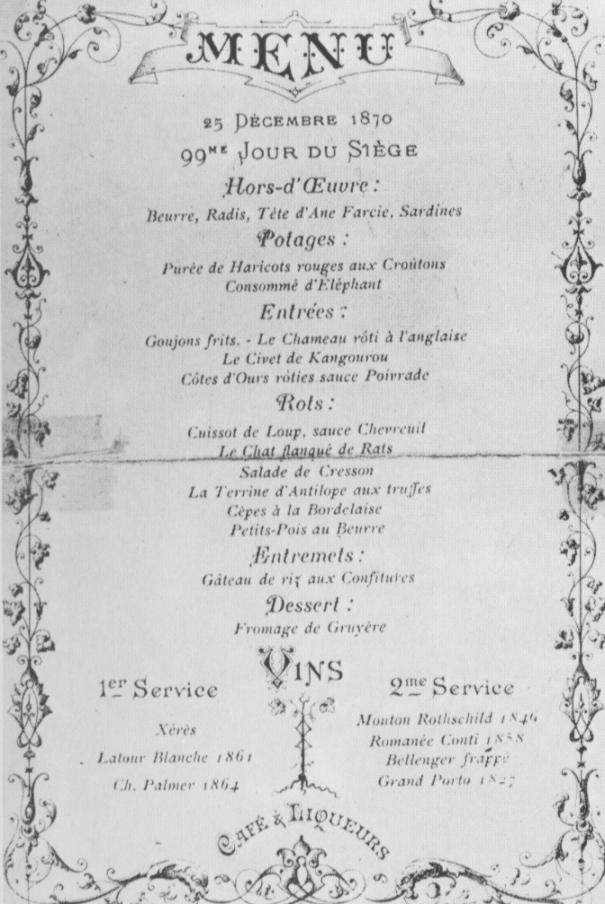
Here’s where things get wild. During the siege, Paris was completely blockaded by the Prussian forces, and the food situation got dire. So bad, in fact, that once the Parisians finished eating all of the cats, dogs and horses in the city, they turned to eating some of the animals from the Jardin des Plantes zoo. Yeah, I had to read that couple of times too. We’re talking Côtes d’Ours (Bear Ribs), Chat flanqué des Rats (Cat with Rats), and Cuissot de Loup, Sauce Chevreuil (Haunch of Wolfwith a Deer Sauce) showing up on menus. It’s almost unimaginable now.
As for the elephants, their names were Castor and Pollux, and according to some survivors of the siege, they weren’t particularly appetizing.